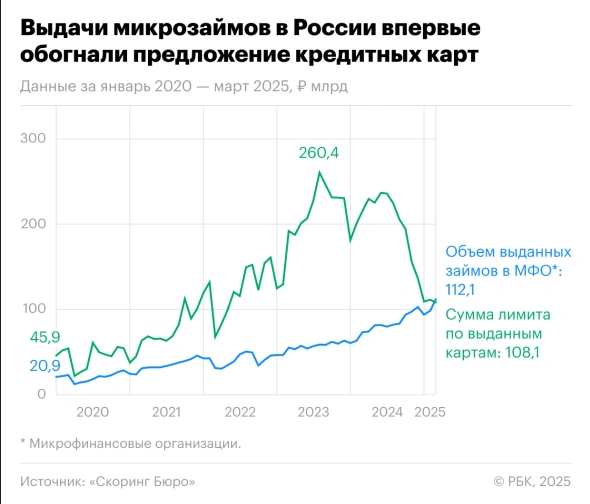
In March 2025, microloan issuance in Russia exceeded credit card supply for the first time since the start of the study, according to statistics from the Scoring Bureau.
During the reporting month, microfinance organizations (MFOs) provided loans to clients totaling 112.1 billion rubles, according to one of the credit bureau’s reviews. And for new credit cards issued in March, the limit amounted to 108.1 billion rubles, the Scoring Bureau reported in response to an inquiry from RBC. Prior to this, since at least 2020, microloan issuance in Russia had been significantly lower than credit card sales. A convergence of these figures was observed only at the peak of the 2020 and 2022 crises, but MFOs had never previously outsold the bank credit card segment in terms of sales.
Compared to February, loan supply in the MFO segment increased by 13.8%, while credit card issuance decreased by 2.9%. In year-on-year terms, the trend is even more pronounced: the amount of microloans issued to individuals increased by 52.7%, while in the credit card segment, volumes fell by 49.8%.
Why credit cards are losing out to microloans
At the beginning of 2025, banks slowed credit card issuance, and against this backdrop, microfinance organizations’ performance improved, says Suren Asaturov, Director of ACRA’s Financial Institution Ratings Group. He attributes this to the increased impact of the Central Bank’s tightened bank regulation, as well as high interest rates.
«Most credit cards offer a grace period, which could mean a loss of potential income for banks,» the expert explains.
Ivan Uklein, Senior Director of Bank Ratings at Expert RA, also cites these factors and highlights another: the end of the Central Bank’s moratorium on non-compliance with restrictions on the total cost of loans (TCO) in the credit card segment. At the end of last year, the regulator allowed banks to relax credit card rates for one quarter; the relaxation expired on April 1.
«Microloans proved virtually unaffected by the key rate increase in 2023-2024 from 7.5% to 21%, while for retail banking, such a significant change in the base rate proved to be a significant factor in slowing new issuance. Especially the increase in the key rate from 18% to 21%, which, together with the tightening of the risk-weighting matrix [for loans], made the unit economics of credit cards almost negative,» explains Ukleyin.
Source: www.rbc.ru